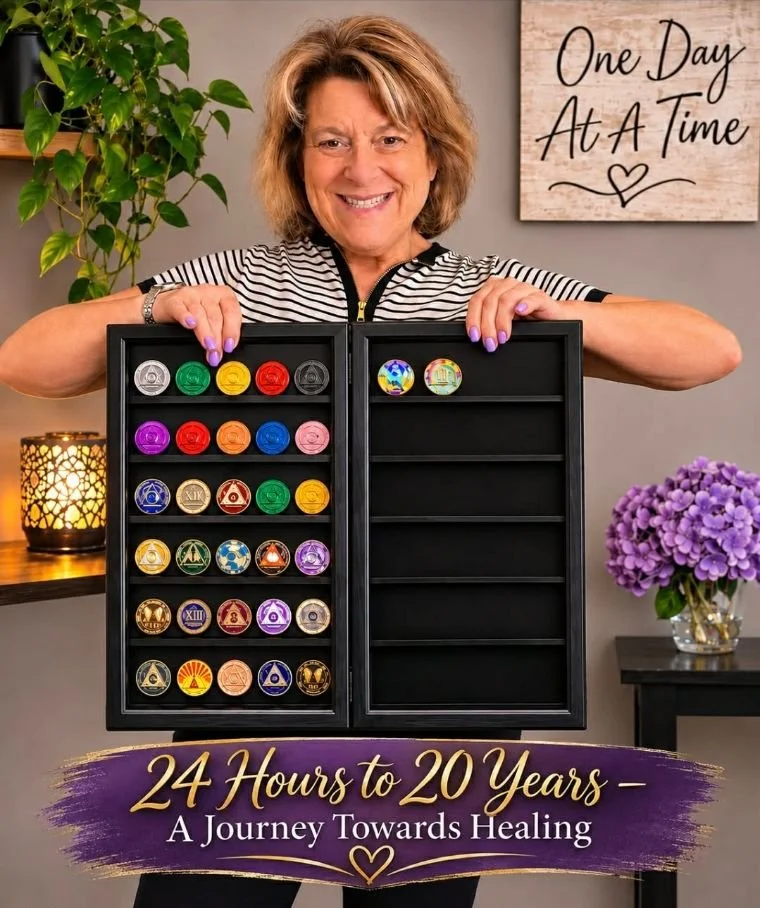
24 Hours to 20 Years - A Journey Towards Healing - Gina's Story
Back in the day - Junior High School there was a girl I knew named Gina. She always had a smile on her face, and a silly sense of humor. She could be loud and boisterous at times, and you always knew when she arrived. I always loved her BIG presence. She made me laugh and smile. Funny thing, way back when - she never knew that she brought brightness to my day because you see my world at that time was very dark and I carried it silently.
Who knew she carried things silently as well. This theme was the sign of the times. The late 70s and 80s, when family business stayed in the family and you carried on like everything in life was perfect. The reality was - that was far from the case.
Gina took her first drink at the age of 14, and that moment created a pivot in life for her that she never saw coming. She traveled down a tourmotuous path for many years, until she hit rock bottom. It was there that she found the strength and courage to break the silence of her “internal pains” and faced the reality of where she was in life. She was an aloholic and drug addict living in the thick of it one hundred and ten percent. Addiction took everything away from her, even her humor.
The story - how did she get there, and what was it that saved her life. Loss, trauma and addiction go hand in hand when you are internally struggling with life. During these times of struggle your mental health is compromised. How does someone overcome so much pain?
I am sharing Gina’s story because it is profound, powerful and allows people to see an intimate view of how it can all fall apart. It shows people that they are not alone in their own despair, and help comes in many different forms. This journey is a combination of generational traumas, mental health struggles and an addition that took hold to the depth of complete darkness. It also shows great courage, strength and determination to find the light once again and bring that humor back into her heart. This is an authentic and vulnerable look at the reality of life.
This is Gina’s story and I am so humbled and proud of her for allowing me to share this with all of you. She is a true Life Warrior and a great example of how you can beat the odds with hope and faith leading the way. Thank you so much Gina for being an inspiration to all of us. Keep on Shining Bright.
Gina’s Journey towards freedom…
1. Describe your childhood – strict Italian home – family dynamics in the early years.
I grew up in a very strict Italian household with my two older brothers. My mother worked very hard, and so did my dad until he got sick and passed away in 1986. My dad was very strict, but when he reprimanded us, we listened! LOL.
I had a close relationship with both my mom and my dad. We had everything we ever needed growing up. My parents made sure we were taken care of, and my brothers and I always had great Christmases and wonderful gifts.
There was no alcoholism or addiction in my family growing up. The only physical discipline was the old-fashioned kind that some families used back then, like a backhand or the belt when we got in trouble! LOL. Looking back, I had a good childhood, and I knew my parents loved us.
2. Talk about your first drink – what was the attraction and how you felt about wanting more, even though it was not a good experience.
I took my first drink at 14 years old. My brother was having a party in our backyard for his 16th birthday. He's only 18 months older than me. I remember drinking beer and getting really drunk. I was sitting in my dad's recliner, and I remember the chair spinning around. I felt absolutely horrible and was really sick and hungover the next day.
You would think that after feeling that bad, I wouldn't want to drink again, but I couldn't wait to do it all over again! Looking back today, I honestly believe I was an alcoholic from the very first sip. Even though I felt terrible physically, something inside me wanted more. I didn't understand it at the time, but looking back, I can see that there was something different about my relationship with alcohol right from the beginning.
3. You married at the age of 17, quitting school (GED) – Really think back and let's ask this question: WHY? Why would you want to marry at such a young age? Did your strict home life have anything to do with this decision?
I got married at 17. We had been dating since I was 14, and I was in love with him. I was already drinking and dabbling in drugs, and looking back, I think part of me also wanted to get out from under my parents' roof and have my own freedom.
I was very young and didn't have the life experience to understand what marriage really meant or what the future might hold. At that age, I thought I was in love and knew what I wanted. Looking back now, I can see how young and inexperienced I really was.
4. Describe your relationship with your husband in the early years. When you were dating – was he controlling and abusive at that time, or was it a healthy relationship? Again, you were very young, only 14 when you started dating.
When we started dating, I was only 14 years old, and I was in love with him. In the beginning, our relationship was good. He wasn't controlling or abusive when we first started dating, and I didn't see those signs in him. We had good years together, and I never imagined things would turn into what they eventually did.
It wasn't until about five years into our marriage that the controlling behavior and abuse started. I didn't go into that relationship expecting to be abused. At 14, I was just a kid who fell in love, and I had no idea what the future would hold.
5. When did the marriage turn abusive and how did that affect your decision making?
The abuse started about five years into our marriage. By then, we had been together for years, and my life had become complicated. As the controlling behavior and abuse got worse, I felt trapped, afraid, and unsure of how to get out.
My drinking was also getting worse. Alcohol became a way for me to escape what was happening and avoid feeling the pain. Instead of dealing with things clearly, I was trying to numb myself.
Looking back, I can see how fear, alcohol, and my age affected my decisions. I didn't have the tools or the self-worth I needed to recognize what was happening and make healthy choices for myself. It took time for me to understand that I couldn't control another person's behavior and that I deserved to live without abuse.
6. When your father passed away you were actively into addiction. Explain how that affected you moving forward.
My dad passed away in 1986 when he was only 50 years old. I was 20. He had heart disease and cancer, and I was Daddy's Little Girl. Losing him was devastating. I felt totally jipped. I couldn't understand why I had to lose my dad so young.
I remember being at his wake, and all I wanted to do was leave and drink. I wanted to drown my grief because I didn't know how to deal with it. I didn't know how to sit with those feelings or work through them, so I wanted to shut them off.
Looking back, I can see how I used alcohol to escape pain instead of facing it. Losing my dad was one of the hardest things I went through, and I carried that grief with me. I didn't understand then that drinking wasn't helping me heal. It was just allowing me to avoid the pain for a little while.
7. Poor relationships moving forward after you and your husband split. All addictive relationships. You were ultimately pushed down stairs breaking your neck. What was the draw to stay in these types of relationships? Codependency.
After my first marriage ended, I felt like I needed a man in my life to feel loved, wanted, and complete. I was afraid to be alone. I didn't realize how much I depended on relationships to make me feel okay about myself.
I was very codependent. I thought I could fix people or change them, and I kept trying to make relationships work even when they weren't healthy for me. I thought if I loved someone enough or did enough for them, things would get better.
One relationship became extremely abusive. I was pushed down a flight of stairs and broke my neck. It took a long time for me to understand that I couldn't fix somebody else, and I couldn't find my worth in another person.
Looking back, I can see that I was trying to fill a hole inside me. I wanted to feel loved and needed, but I didn't know how to feel whole on my own. Recovery helped me understand that I had to work on myself and learn to value myself instead of looking for someone else to make me feel complete.
8. Your last drink – 12/31/2005. What made you decide to stop and change your life?
My last drink was December 31, 2005. I started my sobriety on January 1, 2006. I had reached a point where I was exhausted. Addiction had taken so much from me, and I knew I couldn't keep living the way I was living.
I had actually gotten clean in NA back in 2001 and stayed clean for 18 months. But I didn't do the work I needed to do to change myself. I stopped using, but I didn't change the way I thought, felt, or lived. Eventually, I went back out.
This time, I knew I needed something different. I went to a New Year's Alcathon in Milford and got involved in AA. I started going to meetings, sometimes three meetings a day, got a sponsor, began working the Steps, and took lots of AA commitments. Being in service to AA was a real game changer!
I realized that stopping drinking wasn't enough. I needed to change my life from the inside out. I needed help, and I needed to be willing to do the work. That decision changed everything for me. As a direct result of the 12 steps of Alcoholics Anonymous, I was able to forgive the men who had abused me and we now trudge the road to happy destiny as the man who broke my neck and I, are both members of AA and have done the work. We have found forgiveness through the amends process. It really is quite amazing! I'm so grateful for his friendship today.
9. The spiritual journey towards freedom? Explain (mind, body, spirit). The spiritual high – Recovery.
For me, recovery became about so much more than just putting down a drink. It was about healing my mind, my body, and my spirit. That's why I believe we need to talk about all three.
The mind: My mind was affected by years of drinking, fear, shame, resentment, and trying to control everything around me. I had to learn how to think differently, take an honest look at myself, and stop running away from my feelings. Working the 12 Steps helped me understand my part in things and change the way I looked at myself and the world.
The body: My body had been through a lot, too. Getting sober meant I wasn't putting alcohol into my body anymore. It meant beginning to take better care of myself and respecting the life I had been given. I have also lost over 75 lbs by working the 12 steps in other areas of my life. They work if you work 'em!
The spirit: This is where the biggest change happened for me. I grew up believing in God, but I often felt like God was punishing me. As my addiction progressed, I thought I had done too much wrong and was beyond redemption. Through AA, working the Steps, and learning to turn my will and my life over to God, I began to experience a peace I had never known before.
I learned that I didn't have to keep carrying the shame of my past. I could take responsibility, make amends where possible, and move forward. I began to trust God instead of always trying to control everything myself.
If I just trust Him and stay in His will, my life is amazing.
For me, the spiritual high of recovery is the freedom and peace I have today. I don't have to drink to escape my feelings, and I don't have to live in shame or fear. I have a relationship with God, a program that helps me stay accountable, and a life I never thought possible when I was drinking.
I used to believe I was beyond redemption. Today, I know that I'm not.
10. The importance of the 12-Step program and why you believe in it.
I believe in the 12-Step program because I've lived it. I know what my life was like before, and I know what my life is like today. AA gave me a way to look at myself honestly, take responsibility for my part, and learn how to live differently.
I had tried to stop before, but I hadn't done the work I needed to do on myself. This time, I got a sponsor and worked the Steps. I learned that recovery wasn't just about not drinking. It was about changing the way I think, the way I react, and the way I treat other people.
My sponsor, the fellowship, and the Steps have been such an important part of my life. I've also had the privilege of sponsoring other women and sharing what I've learned along the way.
I got into Alcoholics Anonymous and stopped drinking because I wanted a better life, and now I stay because I have one.
11. 12 Steps – Surrender to the process – It only stings for a bit. Explain your thoughts and feelings surrounding this statement.
For me, surrendering to the 12-Step process means being willing to do the work, even when it's uncomfortable and even when I don't want to look at certain things about myself. It's about letting go of my own ideas of how things should be and trusting the process enough to follow the Steps.
When I worked the Steps, I had to look at things I had spent years avoiding. I had to face my resentments, my fears, my behavior, and the ways I had hurt people. That's not easy. Nobody wants to look at the things they're ashamed of or admit where they've been wrong. It's uncomfortable, and sometimes it hurts.
But that's where the statement “It only stings for a bit” comes in. The truth might hurt in the moment, but that feeling doesn't last forever. What lasts is the freedom you get when you stop carrying all that stuff around with you. The pain of being honest is temporary, but the peace that can come from it is something you get to keep.
I had to learn that I couldn't just pick and choose the parts of recovery that felt comfortable. I had to surrender and be willing to do the work. I had to stop running away from my feelings and start facing them.
The Steps aren't about beating yourself up over your past. They're about being honest, taking responsibility for your part, making things right where you can, and learning to live differently.
Sometimes the things we most want to avoid are the very things we need to face to move forward. It might sting for a bit, but staying stuck in our old ways can hurt for a whole lot longer.
12. You call yourself a “Recovered Alcoholic/Addict” – please explain why you use this term and what people need to understand about perspective.
I call myself a recovered alcoholic because that's what the Big Book of Alcoholics Anonymous says, and I believe in the program. In the Foreword to the First Edition, it says:
“We, of Alcoholics Anonymous, are more than one hundred men and women who have recovered from a seemingly hopeless state of mind and body.”
It goes on to say that the main purpose of the book is to show other alcoholics precisely how they have recovered.
So when I call myself recovered, I'm not saying I'm cured or that I can go back to drinking. I'm saying I've recovered from that seemingly hopeless state of mind and body. I've done the work, worked the Steps, and experienced the changes and promises of the program in my own life.
I understand that some people prefer to say they're recovering, and that's their perspective. I'm not here to tell anyone else what they should call themselves. But I also believe we need to understand what the Big Book actually says. The word recovered is there for a reason, and I don't believe we should overlook it.
For me, being recovered means I don't have to live the way I used to. I still need to practice the principles of AA, stay connected to my sponsor and the fellowship, and continue to grow spiritually. I know where I came from, and I never want to forget it.
13. Moving forward – You now are advocating for addiction recovery, domestic violence awareness and mental health. How has this fulfilled your life?
Moving forward, I've found that sharing my story and helping other people has become a big part of my life. I've sponsored women in AA for many years, and I know how important it is to have someone who understands what you're going through and can offer hope when you can't see it for yourself.
I'm also a survivor of domestic violence, so speaking about abuse and helping bring awareness to it is very personal to me. I know what it's like to feel trapped, afraid, and unsure of how to get out. I want people to understand that abuse is not always obvious in the beginning and that nobody deserves to live in fear.
Mental health and addiction are also important because people are often struggling with things others cannot see. We need more understanding, compassion, and education instead of judgment.
Sharing my recovery journey, including through my videos, gives me an opportunity to reach people who might need to hear that there is hope. I don't claim to have all the answers, but I can share what I've experienced and what has helped me.
Being able to turn the hardest parts of my life into something that might help someone else gives those experiences a different meaning. I can't change my past, but I can use what I've learned to help others. That has brought a lot of purpose and gratitude into my life.
14. What is the message that you want to leave with all of our readers?
I want people to know that no matter how bad things get, there is hope. I know what it's like to believe you've made too many mistakes, that you've lost too much, or that you're beyond redemption. I also know that it's possible to change your life.
Addiction is not simply a lack of willpower, and people struggling with it deserve compassion and help. The same goes for people experiencing domestic violence or mental health struggles. We need to stop judging people by what they're going through and remember that there is a person behind every struggle.
You don't have to do everything on your own. Ask for help. Be willing to listen. Find people who can support you and show you another way to live. You don't have to have everything figured out to take that first step.
My faith in God and my experience in the 12-Step program have given me a life I never thought I could have. I celebrated 20 years of sobriety on January 1, 2026, and I am incredibly grateful for the person I am today.
I am not ashamed of my story. My past is part of who I am, but it doesn't define who I have to be today. If sharing my experiences helps even one person feel less alone or gives them hope that their life can change, then it's worth sharing.
I used to believe I was beyond redemption. Today, I know that I'm not.
In love, service, and gratitude,
Gina Papelo
Gina P